
If you spend any time in NHS technology conversations, one narrative dominates: “We’re a Microsoft-first organisation.” And that makes sense. Microsoft underpins collaboration, identity, and increasingly, the use of AI for operational productivity.
But there’s a problem. Microsoft isn’t the complete answer to frontline communication, patient access, and operational delivery.
And some Trusts are quietly starting to realise that.
This isn’t about replacing Microsoft
Let me be clear. This isn’t a Zoom vs. Microsoft conversation. In every NHS engagement that we’re involved in, Microsoft remains a critical part of the estate.
The real conversation is about what sits alongside it to deliver the things Microsoft doesn’t. Because when you move beyond email, chat, and meetings into patient access, contact centres, telephony resilience, and AI-driven workflows, the gaps become very real. That’s why so many NHS Trusts are running 10, 15, sometimes 20+ additional point solutions to fill those gaps.
And that’s the problem, because point solutions don’t generally integrate well, they don’t scale well, and they don’t support the kind of transformation that the NHS now must deliver.
Telephony in healthcare isn’t just telephony
In many sectors, a phone system is a commoditised business tool. In healthcare, it’s something else entirely. It underpins emergency response, clinical coordination, patient access, and critical operational workflows. And it needs to work even when everything else doesn’t.
This is where cloud-only thinking can fall short, and it’s one of the main reasons that NHS Trusts have historically been cautious about cloud-based telephony.
But with solutions like Zoom Node supporting Zoom Phone, Trusts get the best of both worlds with the resilience of on-premise, and the modern capability that only cloud platforms can provide. Ensuring that if the network drops, core communications can continue.
That’s not a nice to have; it’s essential, and it’s one of several Zoom differentiators in this market.
The contact centre gap
Patient access is one of the biggest pressure points in the NHS today (and one of the most visible). And yet, many Trusts are still trying to solve it with legacy telephony, bolt-on solutions, or tools that are not designed for high volume environments.
This is where Zoom Contact Center changes the conversation. Not as another add-on, but as a core access layer. A single platform for voice, digital channels, intelligent routing, analytics, workforce optimisation, and AI-driven productivity.
More importantly, it allows Trusts to move from simply handling calls, to effectively managing demand, access, and outcomes. And that change matters, because access is now a frontline clinical and operational issue, not just a comms problem.
AI that actually does something
The concept of maximising the potential of AI in the NHS is everywhere right now. But much of it is still stuck in Pilots, POCs, and disconnected use cases.
What’s different here is operational AI, deployed into real services.
With tools like Zoom Virtual Agent, NHS Trusts like Surrey & Sussex Healthcare (SASH) are automating high-volume interactions, reducing inbound demand (like appointment chasing), and providing always-on access across voice and digital channels.
But the real value comes when AI is embedded within workflows. Not just answering questions, but triggering actions, updating systems, and supporting staff in real time. This is the difference between AI as a feature, and AI as infrastructure.
Hospitals Online isn’t a concept. It’s happening
The NHS 10-Year Plan sets out a clear direction:
Analogue → Digital
Hospital → Community
Reactive → Preventative
At the centre of that is the idea of a digital front door, where patients can access services seamlessly, without friction.
And this is no longer theoretical: Zoom Workplace combined with contact centre capabilities is already enabling the 10-Year Plan in several areas, including:
Virtual consultations
Integrated patient communication
Seamless transitions between digital and human interactions
At Surrey & Sussex Healthcare NHS Trust, this approach has helped accelerate virtual hospital capabilities ahead of plan (the Trust has launched a year early). This is what happens when platform thinking, clinical engagement, and the right technology come together.
Designing for the frontline, not just the office
Most NHS workers don’t sit behind desks. It sounds so obvious when you say it out loud, but most of the technology landscape still assumes they do! This disconnect creates friction, inefficiency, and ultimately impacts patient care.
With solutions like Zoom Frontline Worker, Trusts can extend communication and collaboration to clinical teams, operational staff, and distributed workers, connecting the frontline and back office: Something many organisations still struggle to do effectively.
And whilst we’re currently seeing a significant focus on removing analogue paper processes and increasing clinical capacity through ambient voice technologies, NHS Trusts still need to think about how they actually give patients access to the service.
Integration is where the real value is unlocked
Technology on its own doesn’t transform anything. Integration does.
The ability to connect communications with EPR systems, national platforms, and line-of-business applications is where you start to see:
Reduced administration
Improved patient access & reduced DNAs
Better data flow & faster decision-making
Reduced delays in patient discharge
Real, measurable cost savings - supporting NHS CIPs
Zoom’s open API architecture, combined with Acceleraate’s IntegrationHub, makes this level of integration not just possible, but practical, too.
So why isn’t everyone talking about this?
Because the NHS moves carefully (and rightly so).
But what we’re slowly starting to see is a shift in mentality. Forward-thinking Trusts are moving from asking: “What’s our standard stack?”, to: “What actually solves the problem?”
Here’s the story (spread the word!)
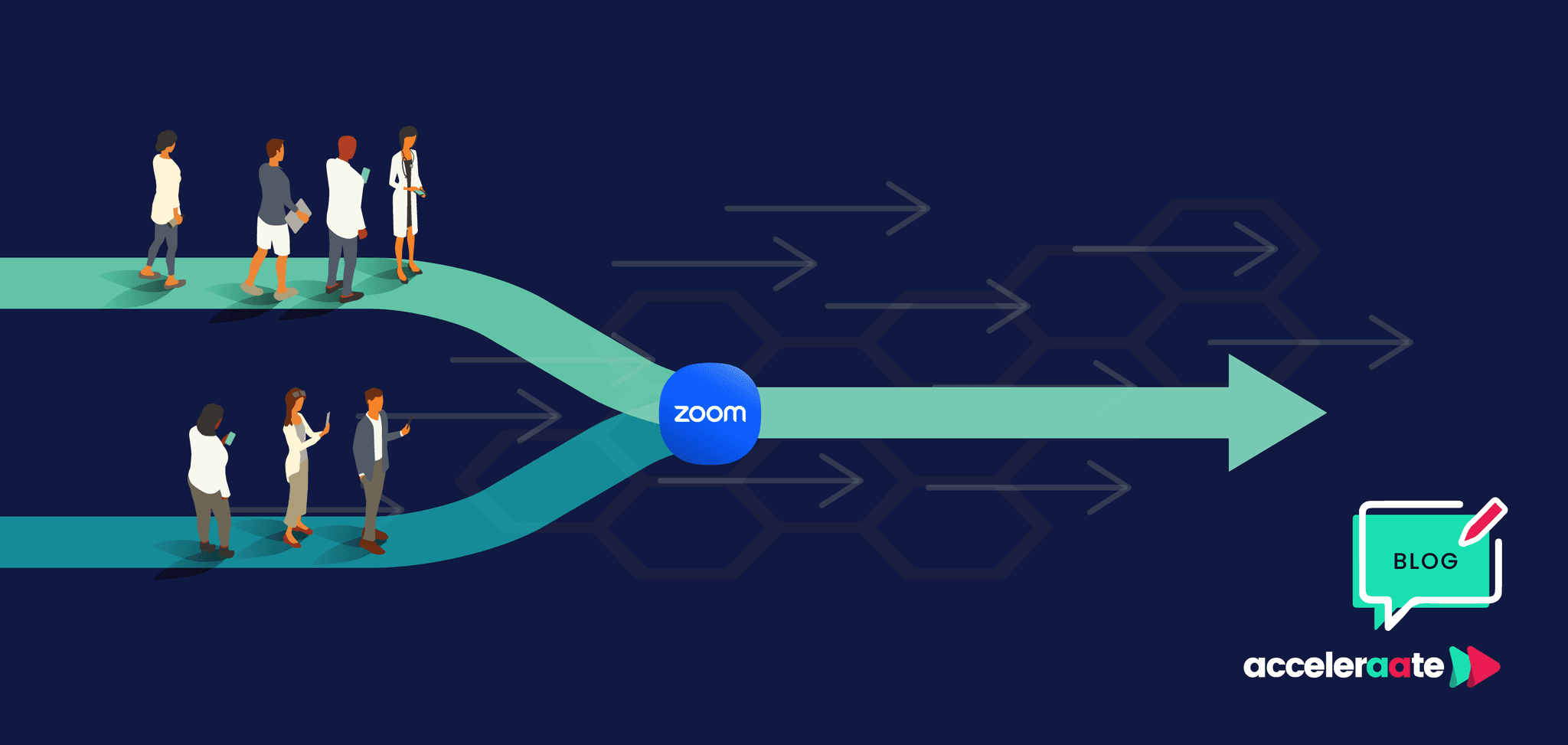
Zoom isn’t trying to replace Microsoft in the NHS. It complements it.
Zoom fills the gaps in:
Telephony resilience
Contact centre capability
Digital front door/Hospitals Online
AI-driven automation
Frontline communication
Workflow integration
And when combined with the right transformation approach, like the one we’ve been working on with SASH, it enables something more important than technology… It enables progress.
Because the NHS doesn’t need more disconnected tools. It needs platforms that consolidate communication, collaboration, access, and workflow into something operationally coherent.
That’s where Zoom stands out. Not as another point solution, but as a platform capable of supporting the kind of integrated, iterative transformation the NHS now has to deliver.
That’s the story that isn’t really being talked about yet.
But it will be.
Healthcare Transformation in the Real World
About the author













 Manchester, United Kingdom


Part of Founded Group Limited