
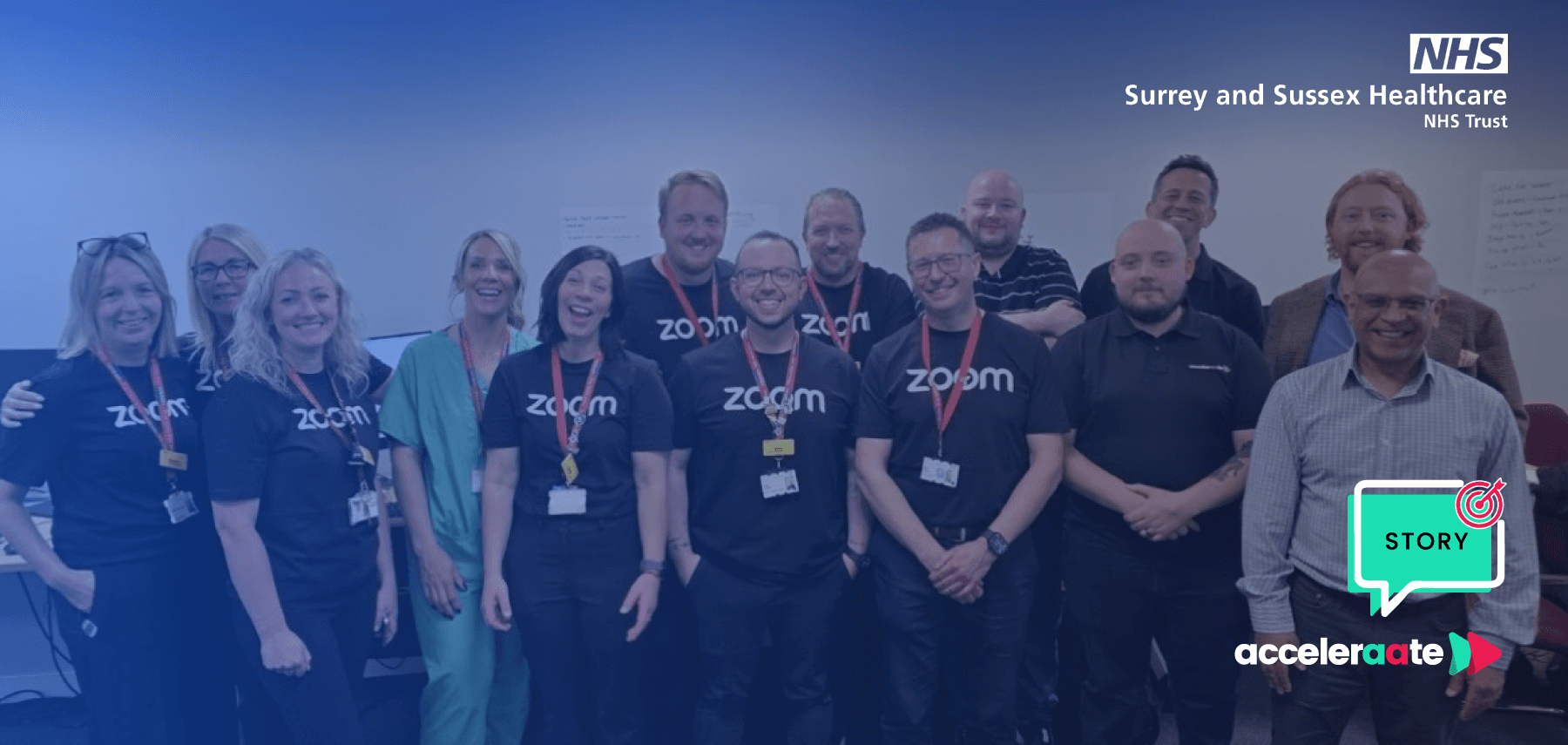
The stakes don't get much higher
Telephony in an acute care hospital isn't an IT project. It's a clinical dependency. When surgeons need to reach anaesthetists, when wards need to coordinate patient transfers, when bed managers need to speak to porter teams, or when an emergency happens the phone simply has to work. Not mostly. Always.
That's what made the telephony transformation at Surrey and Sussex Healthcare NHS Trust (SASH) one of the most demanding migrations we've supported to date. And one of the most satisfying.
2,500 users. 1,200 handsets. A live acute care environment. Legacy on-premise PBX. And a hard target: migrate everything to Zoom Phone, in a day.
We did it.
Why the old estate had to go
SASH, like many NHS Trusts, had telephony infrastructure that was ageing, expensive to maintain, and increasingly fragile. The on-premise PBX estate was end-of-life, dependent on specialist support contracts, and unable to keep pace with the Trust's ambitions around digital transformation, flexible working and the broader Hospitals Online vision.
Beyond cost and complexity, the architecture itself created risk. A centralised on-premise system meant a single point of failure, which is unacceptable in an environment where a lost call can have patient safety implications.
The Trust needed a modern, cloud-based telephony platform. One that could scale. One that could integrate. One that could survive a local network outage without going silent.
Zoom Phone was the answer. But the migration approach would be everything.
The challenge: scale, speed and zero tolerance for failure
The constraints were clear from day one.
Scale. ~2,500 users across a large acute care site, with a mix of desk phones, softphones, shared lines, hunt groups, emergency lines, bleep integration, and clinical team numbers built up over years. The number porting and configuration task alone was significant.
Speed. A phased, multi-month migration wasn't viable. Extended parallel running would have created cost, confusion and operational risk. The Trust needed a clean cutover, with a defined moment where the old system was off and the new one was carrying every call.
Survivability. This was non-negotiable. In an NHS acute care environment, a cloud-only telephony solution that depended entirely on internet connectivity would never pass clinical governance. If connectivity dropped, the phones had to keep working.
Continuity. Clinical teams couldn't be retrained mid-migration. The new experience had to be intuitive, familiar enough to adopt quickly, and supported from go-live.
Zoom Node: the piece that made it possible
The survivability requirement is where many cloud telephony deployments falter in healthcare. SASH wasn't willing to accept a dependency on uninterrupted internet connectivity for core clinical communications. And rightly so.
Zoom Node solved that.
Zoom Node is an on-premise survivability appliance that maintains local PSTN call routing and internal calling capabilities in the event of a WAN outage or cloud connectivity loss. It sits within the Trust's network, registers with Zoom Phone in normal operation, and seamlessly takes over if the cloud connection is lost, keeping calls alive, keeping wards connected, keeping the Trust operational and safe.
For SASH, Zoom Node wasn't a nice-to-have. It was the architectural foundation that made the clinical governance case for cloud telephony. With Node in place, the Trust had the resilience of an on-premise system and the capability of a modern cloud platform.
How we delivered it: the migration approach
Pre-migration: months of preparation, one day of execution
The single-day cutover was only possible because of the depth of preparation that preceded it. In the months before migration day, Acceleraate worked with the amazing SASH+ Digital Transformation team - led by Ben Emly (CDO) and Danni Roullier (Deputy CDO) - and our partners at Zoom to:
Audit and map the entire telephony estate: Every DDI, every hunt group, every shared line, every emergency number, every voicemail configuration and every analogue device
Build and test a Virtual Ward: We stood up a mock ward environment on-site, replicating the physical layout, device placement and call flows of a real clinical area. This gave us a working model to validate design and consolidation opportunities.
Design the Zoom Phone configuration - Site structure, user profiles, auto-receptionist flows, call queues, emergency routing, and device policy
Provision and configure Zoom Node: Installed, tested and validated ahead of go-live to ensure local survivability was proven before a single call was moved
Port all numbers: Coordinated with the carrier and Zoom to ensure all DDIs were ready to transfer on the day, including the Trust's emergency and clinical lines
Prepare and pre-stage every user account: 2,500 Zoom Phone licences provisioned, configured and tested in advance
Rollout Poly handsets: 1,200 handsets provisioned in advance, bagged-up and in position, so that on cutover day SASH colleagues just needed to unwrap the new phone and unplug the old one
Design and deliver user communications: So clinical and administrative staff knew what was changing, when, and what to do
None of this was small work. But it meant that on migration day itself, the team was executing a plan, not discovering problems.
Migration day: controlled, coordinated, clinical
On the day of cutover, Acceleraate's delivery team was on-site alongside a task force of SASH+ and Zoom UK colleagues, working to a detailed run book with defined milestones, go/no-go checkpoints and rollback procedures in place (even if we never intended to need them).
The number port executed. Traffic cut over. Zoom Node was live, and 2,500 users were on Zoom Phone. By end of day, the Trust was fully live on Zoom Phone, and 26,000 calls had already been handled!
What SASH got on the other side
The immediate outcome was a clean, modern cloud telephony platform, but the value goes well beyond that.
Resilience by design: With Zoom Node providing local survivability, SASH has cloud-native telephony with the resilience profile required for acute care. The risk of a single point of failure has been eliminated.
A platform, not just a phone system: Zoom Phone sits natively alongside Zoom Contact Center, Zoom Workplace, Zoom Virtual Agent and Zoom AI, all on a single platform. Telephony is no longer a silo. It's part of the same environment clinical and administrative staff use for meetings, messaging, and increasingly, AI-assisted workflows.
Cost reduction and estate simplification: Legacy PBX infrastructure, associated maintenance contracts and carrier complexity have been removed. The Trust has moved from capital-heavy, depreciation-driven telephony to a predictable, per-user cloud model.
Scalability: Adding users, changing configurations, adjusting routing, all done through the Zoom admin console. No engineer visits. No hardware provisioning cycles.
Visibility for the first time: With legacy infrastructure, meaningful reporting on telephony and contact centre usage was virtually off the table. Zoom gives SASH granular, end-to-end insight across numbers, devices and call activity, so the team can see what's driving demand, identify friction points, and make informed decisions about where AI and automation can add the most value.
The foundation for what comes next: SASH's Zoom Phone deployment is now part of a broader platform story that includes the Virtual Hospital, patient-facing Zoom Virtual Agent, Zoom Contact Center, Oracle Health EPR integration, and AI-enabled workflows. Telephony was the foundation, and now the building is going up.
What this means for other NHS Trusts
SASH proved that a cloud telephony migration in an acute care environment, at scale, at pace, with the survivability that clinical governance demands, is achievable.
It requires the right platform, the right partner, and the right preparation. But it doesn't require months of disruption or extended parallel running.
If your Trust is carrying an ageing PBX estate, facing a support contract renewal decision, or starting to think about how telephony fits into your digital front door and virtual hospital ambitions, the SASH story is worth a conversation.
About Acceleraate
Acceleraate is a Zoom Platinum Partner and the world's first Zoom CX Competency Partner. We are EMEA Zoom Contact Center Partner of the Year 2024 and Zoom Solution Deployment Excellence Partner 2025.
We specialise in Zoom Contact Center, Zoom Phone, Zoom Virtual Agent, Zoom AI, Zoom Workplace and Zoom WEM, and we deliver end-to-end: from discovery and design through to go-live, managed services and continuous improvement.
We work across healthcare, local government, education, retail, utilities and enterprise. Our NHS clients include Surrey and Sussex Healthcare NHS Trust (SASH), and our public sector deployments include Oxfordshire County Council, Reading Borough Council and Buckinghamshire Council.
Ready to modernise your NHS telephony?
About the author














 Manchester, United Kingdom


Part of Founded Group Limited